
A brief says “make it IP68” and everyone nods, because IP68 sounds like the top of a ladder that ends at IP67 one rung below. It is not quite that. The two digits after “IP” each point to a specific test, and the last digit of IP68 points to a test whose depth and duration are set by the manufacturer rather than fixed by the standard. For anyone designing an enclosure, the useful question is not “67 or 68?” but “which test, at what depth, for how long, and against which kind of water?”
Two digits, two separate questions
The code comes from IEC 60529, Degrees of protection provided by enclosures (IP Code). The edition sold today is a consolidated version, 2.2, that folds the 1989 second edition together with amendments from 1999 and 2013, and its scope covers enclosures for electrical equipment with a rated voltage up to 72.5 kV. That is nearly every consumer product with a battery or a mains cable.
The first digit answers a question about solids: fingers, tools, wires and, at the top of the scale, dust. The second digit answers a separate question about water. A product can be strong on one and unrated on the other, which is what the letter X means in a rating such as IPX7: the solids digit has not been assigned a level, not that the product is fragile.
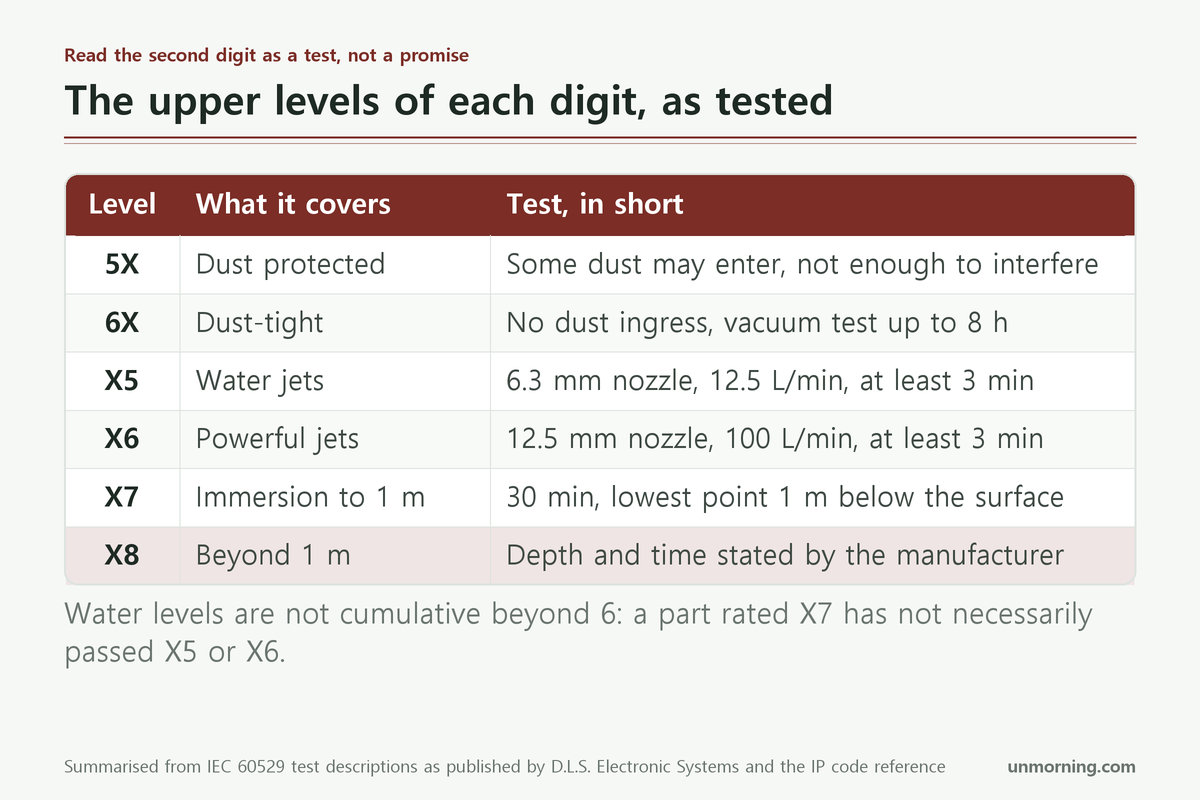
The two highest dust levels are worth separating. Level 5 is “dust protected”: some dust may get in, as long as it does not interfere with safe operation. Level 6 is “dust-tight”: no dust ingress at all, checked in a dust chamber with a vacuum applied to the enclosure for up to eight hours. For a product with a fan, a speaker grille or a pressure vent, the difference between 5 and 6 is a design decision about openings, not a material choice.
Why 7 and 8 do not include 5 and 6
Up to level 6, the water tests escalate in intensity: dripping, spraying, splashing, then jets from a 6.3 mm nozzle at 12.5 litres a minute, then powerful jets from a 12.5 mm nozzle at 100 litres a minute. Levels 7 and 8 switch to a different kind of exposure altogether, immersion. Still water at one metre and a jet aimed at a joint are different loads on a seal, so passing one test says little about the other.
For that reason the water digits are not cumulative beyond 6. A product rated IPX7 has not necessarily been tested against jets, and a product that has passed both kinds of test is marked with both, for example IPX5/IPX7. If your product will be rinsed under a tap or hosed down, an immersion rating on its own does not tell you it will survive that. Specify the jet level separately.
IPX7 is fixed; IPX8 is a promise you have to read
Level 7 has a fixed recipe. The test-laboratory D.L.S. Electronic Systems describes it as immersion with the equipment held at a depth of one metre for 30 minutes; the standard measures from the lowest point of the enclosure, or keeps its highest point 150 mm below the surface, whichever is deeper. Level 8 means immersion beyond one metre, and the same laboratory notes that the conditions should be specified by the manufacturer and may include time and temperature. The standard sets the floor; the product’s own documentation sets the actual depth.
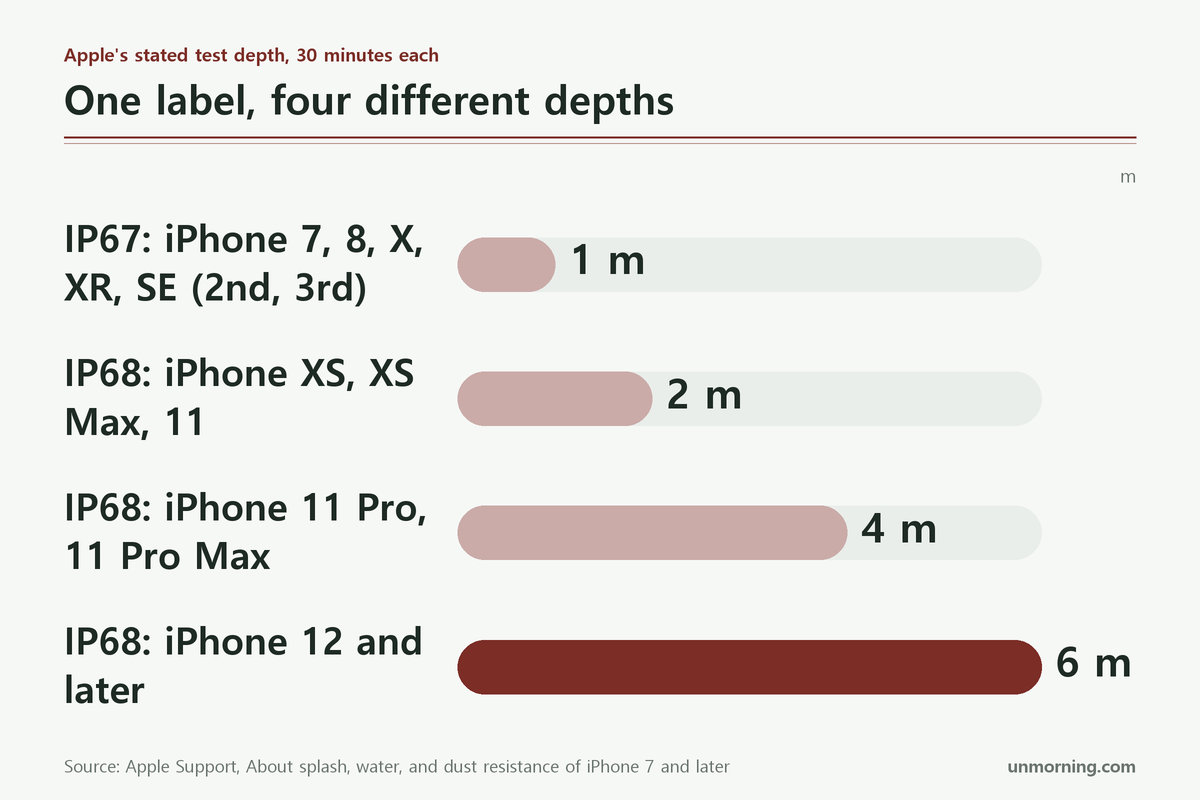
Apple’s support page shows how wide that range can be. Every iPhone from the 12 onward is listed as IP68 under IEC 60529 at a maximum depth of six metres for up to 30 minutes. The iPhone 11 Pro and 11 Pro Max are also IP68, but at four metres. The iPhone 11, XS and XS Max are IP68 at two metres. Older models, from the iPhone 7 to the SE (3rd generation), are IP67 at one metre for 30 minutes. Same two letters, same two digits, three different test depths.
What the rating does not cover
An IP rating is a laboratory result on new units. Apple’s page is unusually frank about the limits: it says splash, water and dust resistance are not permanent conditions and might decrease as a result of normal wear, that liquid damage is not covered under warranty, and it asks owners to avoid swimming or bathing with the phone, saunas and steam rooms, and pressurised or high-velocity water such as showers and water sports. Read as a designer, that list maps directly onto the gaps in the test: hot water, steam, soap, jets, and seals that have been dropped, flexed and aged.
Gaskets compress and relax, adhesives creep, and a button membrane that is flexed thousands of times is not the membrane that went into the immersion tank. Where the seal lines run, and how the housing halves meet, is decided long before testing. The parting line and the way two moulded halves close are covered in our guide to injection molding basics; if those halves need a tight flatness callout to keep a gasket evenly loaded, the notation is explained in how to read a feature control frame.
Write the rating as a sentence in the brief: “Dust-tight; withstands water jets (X5); immersion at 1.5 m for 30 minutes in fresh water at room temperature.” That sentence is testable. “IP68” on its own is not.
Specifying it without surprises
Start from use, not from the highest number. A bathroom scale, a garden light and a dive torch all want different tests. Outdoor fixtures face rain driven from every angle and hose cleaning, which points to the jet levels; the fixture design questions around that are discussed in designing light fixtures. A product that may be dropped in a pool needs immersion, and if you claim level 8, the depth and time you choose become a public promise that customers will compare.
Then decide what happens after the water. Speakers and microphones with membranes, charging ports, and pressure vents each need a test plan of their own, because every opening is a place where the seal design changes. Finally, carry the rating and its exact test conditions into the production documents so that a supplier change in gasket material triggers a re-test. That hand-off step belongs on the production handoff checklist, next to materials and finishes.
Read this way, IP67 versus IP68 stops being a ranking. IP67 is a fixed, comparable test. IP68 is a family of tests that starts where IP67 stops, and the number that matters is the one written next to it.
Sources
- IEC, IEC 60529:1989+AMD1:1999+AMD2:2013 CSV, Degrees of protection provided by enclosures (IP Code)
- Apple Support, About splash, water, and dust resistance of iPhone 7 and later
- D.L.S. Electronic Systems, IPX7 and IPX8 Immersion Testing
- IP code (reference for test parameters)
한국에 온 외국인 친구가 있나요? 메뉴 번역·택시 요금·약국 카드가 한 앱에 있는 K-OREA를 알려 주세요.
Visiting Korea? K-OREA puts menu scanning, taxi fare guidance and a pharmacy card in one app. Get it on the App Store.