
The logo is often the last line on a CMF sheet and the first thing a customer reads. On a moulded plastic part it usually arrives in one of two ways: ink carried on by a soft silicone pad, or a laser that changes the plastic itself. They look similar in a render and behave very differently over five years of thumbs, cleaning wipes and pockets. Choosing between them is mostly a question of colour, shape and wear, in that order.
Pad printing: ink that can follow a curve
Pad printing is an indirect gravure process. The artwork is etched into a flat plate called a cliché. In a sealed ink cup system, an inverted cup of ink slides over the plate, fills the etched image and wipes the rest of the plate clean as it moves. A silicone pad then presses down on the plate; as it compresses, it pushes air outward and lifts the ink out of the etching. The pad carries that film of ink over to the part and presses again.
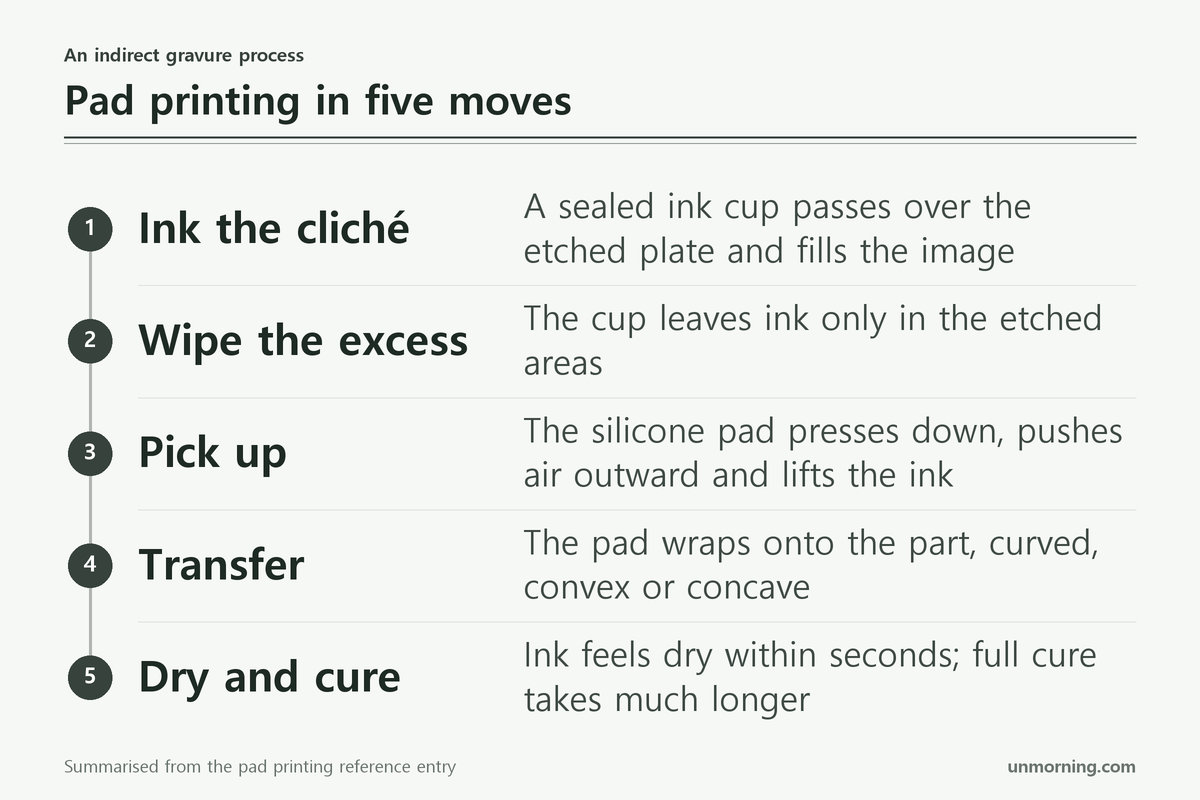
The pad is the reason the process exists. Because it deforms, it can pick an image up from a flat plane and set it down on cylindrical, spherical, concave and convex surfaces. That is why pad printing shows up where precision meets an awkward shape: medical devices, automotive parts such as turn-signal indicators and panel controls, toys and keyboards are the classic examples. Multi-colour artwork is possible by running several clichés in register, one colour per plate.
The ink chemistry matters to a designer for one practical reason. The top layer of pad printing ink becomes tacky as soon as it meets air, which is what lets it leave the pad cleanly. Many of these inks are solvent based and feel dry within seconds, but a full cure can take much longer. A part that looks finished at the end of the line may not yet have the resistance it will have a few days later, so ask when the supplier’s rub and adhesion tests are performed.
Checking that the ink stays put
Adhesion is usually checked with a tape test. ASTM D3359-23 describes two methods of rating adhesion by applying and removing pressure-sensitive tape over cuts made in a coating: Method A for films thicker than 125 µm and Method B for thinner ones. Note the fine print. The standard is written for ductile coatings on metal; it records that the method has been used on plastics and wood but that precision data for those substrates is lacking, and it does not distinguish between higher levels of adhesion. On a plastic housing, treat it as an agreed pass-or-fail gate, written into the drawing with the method named, rather than as a precise score.
Laser marking: changing the material instead of adding to it
A laser adds nothing. It changes the surface that is already there, and the laser maker Trotec separates the ways it can do that into a handful of processes. Four of them matter for plastic parts.
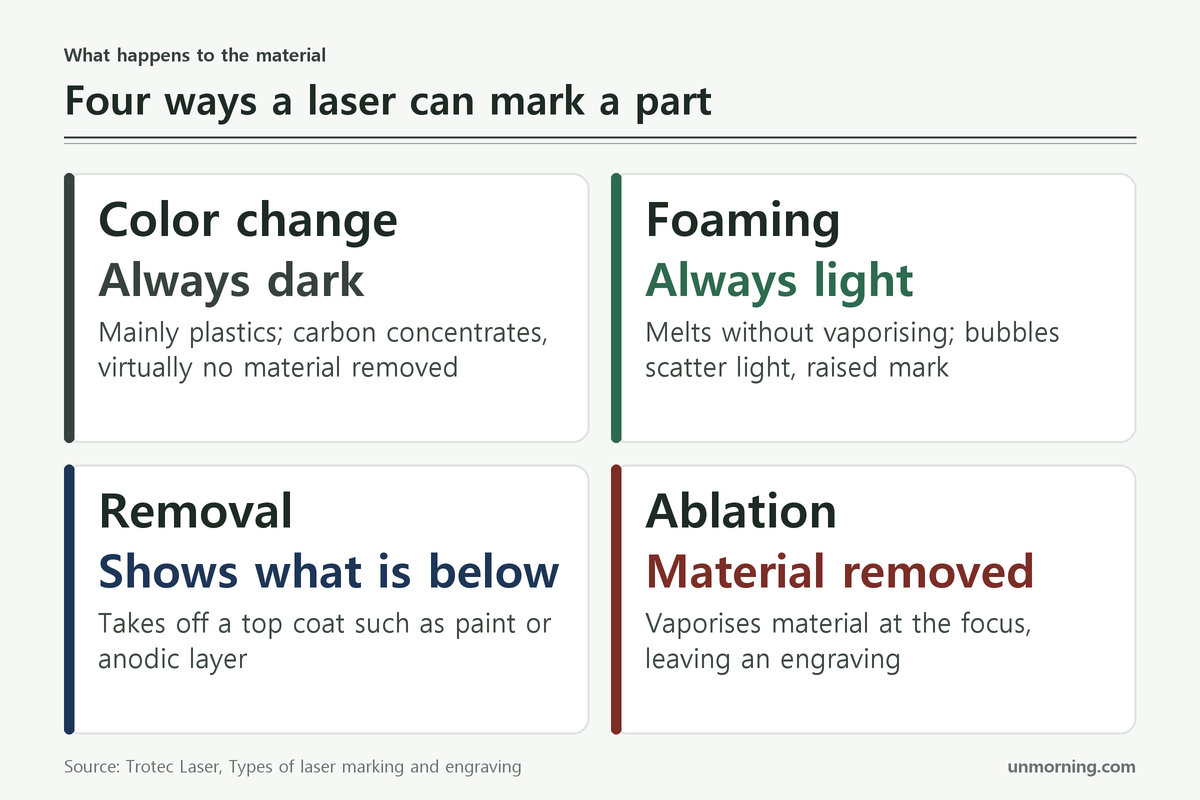
Color change, sometimes called carbonizing, is used mainly on plastics. Volatile components are driven out of the heated zone, carbon concentrates there and the mark turns dark; Trotec says these marks are always dark. Because virtually no material is removed, the surface stays smooth, and the company describes the result as resistant to abrasion, cleaning agents, oil, and weak alkalis and acids.
Foaming works the other way. The laser heats the material above its melting temperature but below vaporisation, gas bubbles form, and they scatter light so the mark looks pale. Foamed marks are always light and slightly raised rather than sunk into the surface. Removal takes off a top layer such as paint or an anodic coating to expose what is underneath, and Trotec notes it is widely used on plastics as well as coated metal. Ablation vaporises material at the focus and leaves a true engraving. A fifth process, annealing, colours steel and other iron alloys through heat and oxidation and does not apply to plastics.
The colour rule of thumb follows directly: on a light resin, a laser gives you a dark mark; on a dark resin, it gives you a light one. If the brand colour is neither, the laser alone cannot produce it, and ink or a coating has to be involved.
Choosing between them
Colour first. If the logo must be a specific brand colour, pad printing is the direct route, and several colours mean several clichés. Laser marks on plastic are limited to darker or lighter versions of the base material, so the logo’s colour is effectively decided when the resin colour is decided. That is worth settling early, alongside the other finish decisions covered in our comparison of plastic finishes.
Shape second. A pad reaches into gentle curves and recesses because it deforms. A laser marks wherever its beam can reach in focus, so steep walls and deep pockets can be a problem for either method; the place to discover that is a sample run on a real part, not a render.
Wear third. A printed mark is a film on top of the part and can be worn away, which is why the tape test and rub tests exist. A color change mark sits in the material, with virtually no removal, so there is no separate film to lose. Removal marking is a hybrid: the symbol is made by taking away a coating, so its durability depends on that coating.
Removal also opens a design option that neither of the others offers. Paint a translucent part, then laser away the paint in the shape of a symbol: the symbol shows the material beneath and, if that material is backlit, it glows while the painted surface stays dark. The finish of that top coat is its own decision, and the trade-offs between painting and other coatings are set out in vacuum metallizing, painting or anodizing.
Whichever route you take, write the logo as a specification rather than a picture: process, colour reference, size and position tolerance, and the adhesion or rub test it must pass. Usage rules for size and clear space belong in the brand system too; how those rules protect a mark is the subject of building brand guidelines. A logo specified that way survives a supplier change; a logo specified as a PNG usually does not.
Sources
- Trotec Laser, Types of laser marking and engraving
- ASTM, D3359-23 Standard Test Methods for Rating Adhesion by Tape Test
- Pad printing (reference for the process sequence and applications)
한국에 온 외국인 친구가 있나요? 메뉴 번역·택시 요금·약국 카드가 한 앱에 있는 K-OREA를 알려 주세요.
Visiting Korea? K-OREA puts menu scanning, taxi fare guidance and a pharmacy card in one app. Get it on the App Store.